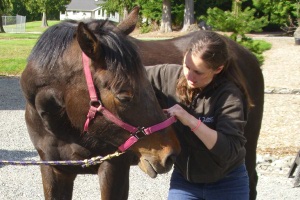
Cedarbrook Veterinary Care's veterinarians are American
Veterinary Chiropractic Association (AVCA) trained veterinarians who
can evaluate and perform adjustments on your horse.
Veterinary Chiropractic (often described as spinal manipulation
therapy) is a holistic approach to healthcare that is based on
symmetry and freedom of movement. It does not replace traditional medicine and
surgery but works in conjunction with traditional veterinary
medicine to improve the health and movement of all the joints in the
body, but especially the spinal column. When used concurrently with
traditional medicine, many of your horse's musculoskeletal
conditions respond dramatically and rehabilitation can take place
quickly and efficiently.
The Spinal Column
Chiropractic care focuses on the health and proper movement of
all joints in the body, but especially, the proper functioning of
the spinal column.
The spinal column is made up of bones (vertebrae), muscles,
ligaments, spinal cord and nerve roots. It functions to support the body and serves
as an attachment for the paraspinal muscles. Nerve roots exit the spinal cord between
vertebrae and communicate information to the entire body. When two
adjacent bones (vertebra) come together they form a joint and there
are over 175 joints in the spinal column.
When these joints are moving normally, the horse is flexible,
happy and healthy. When these joints are not functioning well, the
animal becomes stiff, inflammed, and the nerves that exit the spinal column
through these joints become impinged upon, creating pain and
illness. Over time this pain worsens and we start seeing other signs
including muscle loss, postural changes and lameness.
Subluxation
When used by chiropractors, the term subluxation is used to
describe a very specific condition, or disease, of the spinal column
in which one or more of the joints are not moving properly. When the horse's bones are "stuck", so to speak, this
condition causes a nerve to be "pinched" or compromised. Even
if only one of the many joints of the spine is "stuck", the entire
spinal column will lose flexibility and the horse will become stiff,
resistant, and begin to show signs of poor performance and/or
health.
Keep in mind that nerves branch off the spinal cord and travel
through these “stuck†areas. Misaligned and "stuck" vertebral joints
can affect the nerves as they exit. These nerves are the
communication lines between the brain and the rest of the body,
carrying impulses both to and from all of the structures in your
horse, down to every last cell. When a horse has a subluxation, it
affects those lines in a detrimental way.
Every movement, from simple swishing of the tail to the piaffe in
dressage, requires a constant synchronization of many muscles, some
contracting, some relaxing. The communication lines that allow this
precision motion are the nerves. If these are “pinchedâ€,
incoordination will result. Major, long-term interference can cause
lameness/laminitis, while minor interference may cause only minor, almost
imperceptible changes. More importantly, lack of coordination in
these movements can cause missteps, or improper gaits, that can lead
to damage in the remaining healthy joints such as stifles, knees, or
elbows. In addition, "pinched" nerves are painful, no matter how
slight. Pain will also prohibit your horse from working to his
maximum potential.
Adjustments to Improve Motion
Chiropractic evaluates the entire spinal column looking for
vertebrae that are not moving well. When these areas are identified
they can be adjusted with very specific rapid thrusts to improve the
motion at that particular location.
A veterinarian trained animal chiropractor should make final diagnosis of
subluxations. Once identified, the doctor will attempt a correction
of the subluxated or "stuck" vertebra. This correction is called an
adjustment. An adjustment is performed onto a vertebra in a very specific direction (line of correction) that will restore movement
to a fixated joint. Improper or forced adjustment can be harmful to your horse. Working with a properly trained bodyworker with
the accountability that comes with credentials (i.e. a veterinarian certified in animal chiropractic) is important!
Chiropractic is very specific, and adjustments are made on each
vertebra directly. Jerking on legs or tails is not an adjustment. A
proper examination and evaluation by the doctor is necessary to
determine what needs to be adjusted, and more importantly, what not
to adjust. While delivering an adjustment the doctor uses a
controlled force. Large horses don't necessarily need more force
than very small ones. Each joint of the spine is moveable, and if
the correct angle is used and the patient is compliant, the adjustment is relatively easy using
low force.
While an animal chiropractor will pay particular attention to the
spine, they may also adjust the joints of the jaw, legs, pelvis, or skull.
Please call Cedarbrook Veterinary Care at (360) 794-9255 to see
if chiropractic is right for your horse.